- The Chronicles Newsletter
- Posts
- Mental Enrichment = Better Behaviour
Mental Enrichment = Better Behaviour
Tire the brain, not just the legs

Greg Burke
March 05, 2026

In partnership with

Three Shelties. One house. A full committee of opinions.
The Chronicles Newsletter publishes the First and Third Thursday of every month.

One of the most common beliefs among dog owners is that if a dog gets enough physical exercise, good behavior will naturally follow. Walk the dog long enough, throw the ball enough times, and eventually you’ll end up with a calm and cooperative companion.
Sometimes that works.
But often it doesn’t.
Many owners discover this the hard way when they return from a long walk only to watch their dog immediately begin barking at the window, stealing socks, or inventing creative ways to redecorate the living room.
The problem is simple: a tired body does not always mean a satisfied mind.
Dogs were not designed to simply burn energy by running in circles. For most of their evolutionary history they were problem-solvers, trackers, hunters, and partners in human work. Their brains evolved to process information, follow scents, solve challenges, and make decisions. When those instincts go unused, the brain starts looking for something to do.
And if the brain gets bored, it will invent its own entertainment.
Unfortunately, dogs are often terrible interior decorators.

Mental enrichment is one of the most powerful tools we have to improve behavior because it taps directly into how dogs naturally operate. When a dog is thinking, problem-solving, sniffing, and learning, the brain begins to tire in a way that pure physical exercise rarely achieves.
Five minutes of real thinking can sometimes equal the fatigue of a thirty-minute walk.
You see this clearly during training sessions. A focused ten-minute training game—working on tricks, shaping behaviors, or solving simple puzzles—often leaves a dog lying down afterward, quietly satisfied. Not because their legs are tired, but because their brain just finished a workout.
Sniffing is one of the simplest and most effective forms of enrichment. A dog’s nose is an extraordinary instrument, capable of detecting scents at levels humans cannot even comprehend. Allowing dogs to use that nose is mentally demanding in the best possible way.
This is why a “sniff walk” can be more enriching than a fast march around the block. When the dog is allowed to pause, investigate, and process the scent world around them, their brain is actively working the entire time.
Food puzzles and scent games are another excellent outlet. Instead of simply placing food in a bowl, scatter feeding in the grass or hiding treats around the house turns dinner into a small hunting expedition. The dog must search, investigate, and problem-solve to find the reward.
Suddenly dinner becomes an activity instead of an event that lasts eight seconds.
Training itself is also one of the best forms of mental exercise. Teaching a dog new skills—whether it’s basic obedience, tricks, or cooperative care—requires concentration and communication. Dogs enjoy learning when it is presented as a game, and the process strengthens the bond between dog and owner at the same time.
And here is the interesting part.
Many behavior problems are not actually caused by excess energy. They are caused by unused intelligence.
A clever dog with nothing to think about will invent jobs for itself. Guarding the window, reorganizing the laundry basket, or conducting unauthorized shoe inspections may not be the jobs we had in mind, but from the dog’s perspective they are perfectly reasonable projects.
Mental enrichment gives the dog a better job.
This doesn’t mean physical exercise isn’t important. It absolutely is. Dogs need movement, fresh air, and activity for both physical health and emotional balance. But exercise alone is only part of the equation.

A balanced dog usually has three needs met every day:
• Physical exercise
• Mental stimulation
• Social interaction
When all three are present, behavior tends to improve naturally.
What surprises many owners is how little time this actually requires. A few short training games, a scent hunt in the yard, or a puzzle feeder at dinner can dramatically change how a dog behaves throughout the day.
Instead of searching for trouble, the dog has already done meaningful work.
And like most of us after a productive day, they are far more inclined to relax afterward.
So if your dog seems restless, destructive, or endlessly energetic despite regular walks, the solution may not be longer walks.
It may simply be a better workout for the brain.
A tired body sleeps.
But a satisfied mind rests. 🐾

Today’s Question: “Cricket, how do dogs always know when it’s dinner time? My dog shows up in the kitchen at the exact same time every day.”
Cricket’s Answer:
That’s actually a very good question, and the answer involves biology, observation, and a little bit of human predictability.
Dogs have something called a circadian rhythm, which is essentially an internal clock. Their bodies learn when things usually happen—like walks, bedtime, and most importantly, dinner. After a while, their brain begins anticipating those events before they happen.
But that’s only part of it.
Dogs are also extremely good at detecting patterns in human behavior. If you usually feed your dog around 5:30, your dog has probably noticed several clues you don’t even realize you’re giving. Maybe you stand up from your chair, close your laptop, or walk toward the kitchen in a particular way. To a dog, those tiny signals are like a giant flashing sign that says:
“Food event approaching.”

And once a dog figures out the pattern, they start arriving early… just in case.
In fact, Kevin once began waiting by the food bowl forty minutes before dinner, which is not impressive timing, but it is impressive optimism.
So the short answer is: dogs don’t actually know what time it is.
They just know you very, very well. 🐾
Biscuit turns 6! … or is that 1? Problems with being born on February 29th. See our latest on YouTube!
Before you go: Mental stimulation is a win-win-win. You and your dog have fun together, your dog is exhausted, and your bond is that much stronger. Greg Burke
A Note from our Sponsor:
Smart starts here.

You don't have to read everything — just the right thing. 1440's daily newsletter distills the day's biggest stories from 100+ sources into one quick, 5-minute read. It's the fastest way to stay sharp, sound informed, and actually understand what's happening in the world. Join 4.5 million readers who start their day the smart way.
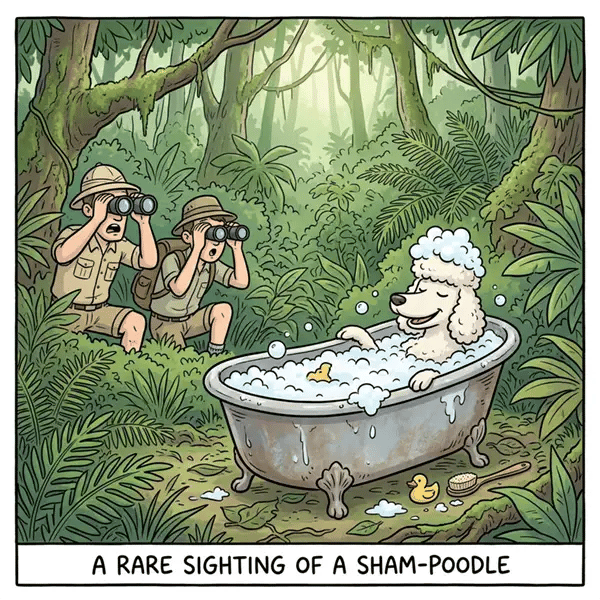
Cartoon of the Week!
Want more tips, tricks, and tail-wagging tales? Visit our blog anytime at cricketchronicles.ca!
Until next time,
The Dad, the Mom and all the Pups!
The Chronicles publishes at the beginning of every month and in the middle.
Add your email to get every edition!

1